Selecting the right raw materials is the foundation of reliable diamond polishing pads for the stone fabrication industry. With more than 30 years of manufacturing and export experience, we have developed material selection protocols and production formulas that address the distinct needs of granite polishing, marble finishing, and concrete polishing applications while supporting OEM programs and high-volume factory output.
Bond type is the primary determinant of pad behavior on different substrates. Resin bond pads, formulated from thermosetting polymers and engineered fillers, are typically used for fine grinding and high-gloss finishing because they deliver controlled cut rates and superior gloss. Metal bond pads, produced by sintering metal powders with diamond, provide aggressive cutting and long life on hard, abrasive materials. Hybrid bonds combine resin flexibility with metallic fillers to strike a balance between speed and durability; these are often specified for transitional steps in multi-step polishing sequences or for mixed-material jobs.
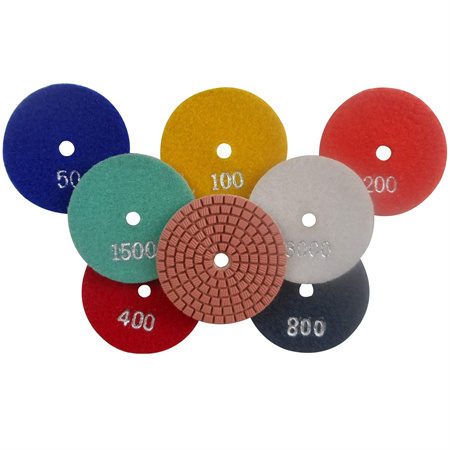
Synthetic diamond quality and grading demand careful attention. Industrial HPHT synthetic diamonds remain the mainstream abrasive for polishing pads due to consistent crystal structure, controlled particle size distributions, and predictable friability. We select diamond lots based on grit distribution, shape uniformity, and friability ratings, and control diamond concentration (carat loading) in each resin or metal matrix to meet specified cut rates and lifespan targets. Grit systems are configured to common stone fabrication sequences: coarse for initial profiling, medium grits for scratch removal, and fine/ultra-fine grits for final polishing. Typical offerings span from coarse discs through multi-thousand grit finishes, enabling workflows for both granite and marble finishing as well as concrete floor systems.
Production processes influence final performance. Resin diamond pads are manufactured by precise mixing of resin, fillers, and diamond, followed by cold or hot pressing into molds and controlled curing cycles to achieve consistent cross-link density and hardness. Metal bond pads are produced using powdered metal compaction and high-temperature sintering to embed diamonds in a rigid matrix. Hot pressing can improve density and bonding, while carefully controlled cold pressing followed by staged curing can optimize elasticity for flexible pads. Our formula development experience allows modification of polymer systems, fillers, and curing profiles to tune heat resistance, gloss generation, and wear characteristics.
Backing systems are another critical consideration. Hook-and-loop (Velcro-style) backings are standard for ease of pad changes on site; some projects require pressure-sensitive adhesive or permanent fiber-bonded backings for heavy-duty grinding. Pad construction must match the backing system and tooling interface to maintain flatness, reduce vibration, and ensure operator safety.
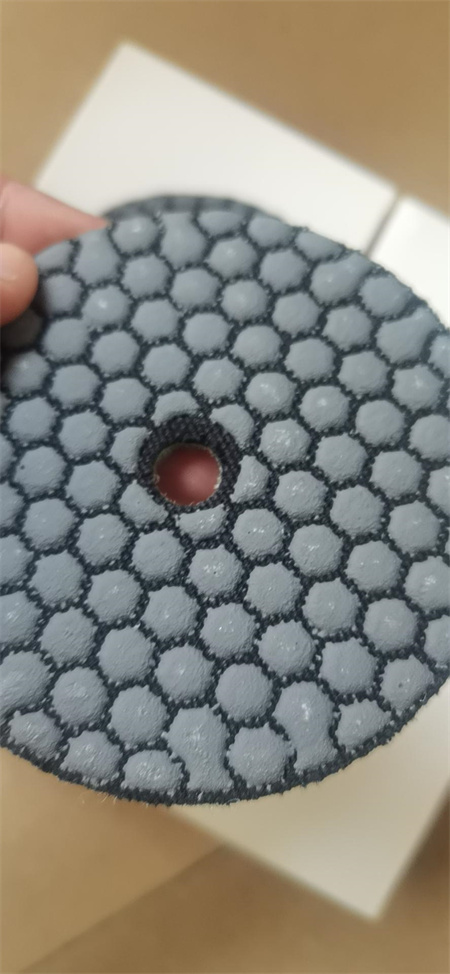
Performance factors we monitor through routine quality control include cutting speed, gloss level (measured with gloss meters on representative stone samples), operating life under standardized conditions, and thermal stability during high-speed polishing. Incoming raw materials undergo inspection for diamond particle size distribution, binder chemistry, and filler quality. Batch-to-batch consistency is maintained through statistical process control, lot traceability, and periodic performance runs on granite, marble, and concrete substrates.
For international shipments, packaging practices focus on protecting pads from moisture, deformation, and contamination. Pads are often vacuum-sealed with desiccants, bundled in reinforced cartons, and palletized in compliance with ISPM-15 requirements for wooden packaging when necessary. Clear labeling of grit, bond type, lot number, and OEM specifications helps distributors and wholesalers manage inventory and traceability across markets.
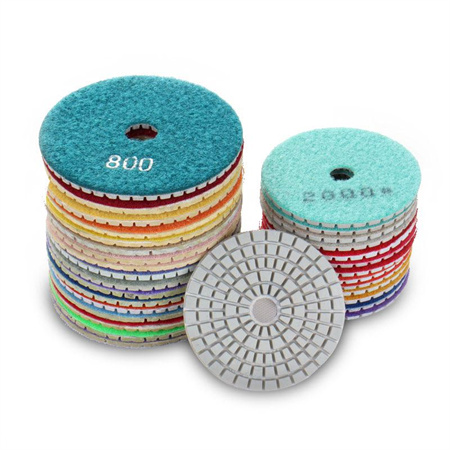
Choosing the right raw materials and manufacturing processes is essential to delivering diamond polishing pads that meet the performance expectations of stone polishing tools users, fabricators, and contractors. A methodical approach to bond formulation, diamond selection, production control, and export packaging enables consistent results across granite polishing, marble finishing, and concrete polishing applications in the global stone fabrication industry.