Quality traceability in diamond polishing pad manufacturing begins long before the product reaches a distributor’s warehouse. For importers, stone tool distributors, wholesalers, and workshop owners, understanding how materials, production processes, and batch controls interact is essential to ensure consistent performance across granite polishing, marble finishing, and concrete polishing projects.
Materials selection is the foundation. Resin bond pads, metal bond pads, and hybrid bond systems each target different stages of stone fabrication and polishing. Resin bond formulations deliver rapid cutting and high gloss on softer stones and for final polishing steps, while metal bond designs offer superior wear resistance and heat tolerance for aggressive stock removal on hard granite and engineered stone. Hybrid bonds combine resin flexibility with metal resilience to balance cutting speed, gloss level, and lifespan. Synthetic diamond quality grades and particle distributions—specified by micron sizes or mesh/grit numbers—directly influence cutting efficiency and finish. Monocrystalline particles provide sharp cutting edges, while polycrystalline grades can offer longer life under certain workloads. Typical grit progressions used in the stone fabrication industry range from coarse cutting grits through progressive polishing steps (for example, 50/100/200/400/800/1500/3000, depending on material and desired gloss).
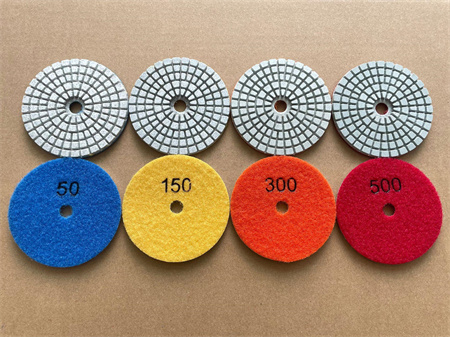
Production processes must be tightly controlled to maintain batch consistency. Hot pressing and cold pressing are commonly used to form the diamond compound; each method requires precise control of pressure, temperature, and dwell time. Subsequent curing cycles stabilize the bond matrix, and small deviations in time or temperature can alter hardness and retention properties. Backing systems—commonly hook and loop (Velcro) or solid resin-backed designs—are integrated during pressing or by post-processing, and proper attachment strength is verified through peel and shear testing to prevent pad separation in field use.
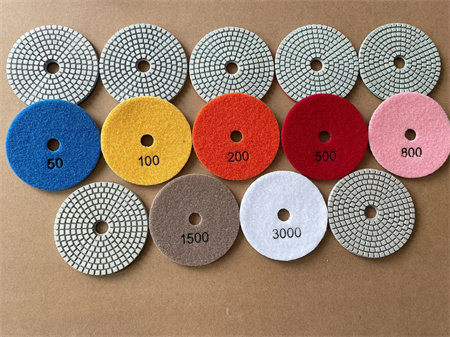
A robust quality control program covers raw material inspection, in-process monitoring, and finished-product testing. Incoming synthetic diamond powders are certified for particle size distribution and concentration; polymer and metal powders are checked for composition and moisture. During manufacturing, weight, thickness, concentricity, and bond density are measured. Finished pads undergo performance testing on representative stone substrates to evaluate cutting speed, gloss level using gloss meters, heat resistance during high-speed use, and expected lifespan through accelerated wear tests. Batch traceability is maintained with lot numbers tied to production records, material certificates, and retained samples, enabling rapid root-cause analysis if field failures occur.

OEM capability and formula development experience are critical for serving international customers with varying stone types and equipment. Long-term formula development enables tailoring bond hardness and diamond concentration for specific applications, whether for heavy-duty granite polishing or delicate marble finishing. Multiple production lines and seasoned operators support stable high-volume output while accommodating custom specifications.
Export packaging and logistics practices also contribute to quality preservation. Pads are typically bagged to prevent moisture ingress, separated with foam or corrugated dividers to avoid abrasion, and packed in labeled cartons with batch information. Palletization considers weight distribution and international shipping standards; wood packaging complies with ISPM 15 when required. Proper documentation, including Certificates of Analysis and packing lists, simplifies customs clearance and acceptance by downstream buyers.
For B2B buyers in the stone fabrication industry, transparency in material sourcing, controlled production processes, and documented batch traceability are the main indicators of supplier reliability. Consistent performance across granite polishing, marble finishing, and concrete polishing applications depends on these disciplined practices and the ability to adapt formulations to specific on-site demands.