Diamond polishing pads are a core consumable for the stone fabrication industry, directly affecting processing efficiency and finished surface quality on granite, marble, engineered stone and concrete. With over 30 years of export experience manufacturing diamond polishing pads for architectural stone projects, we understand how material selection, pad construction, and production control translate into predictable on-site performance for importers, wholesalers, and fabrication workshops.
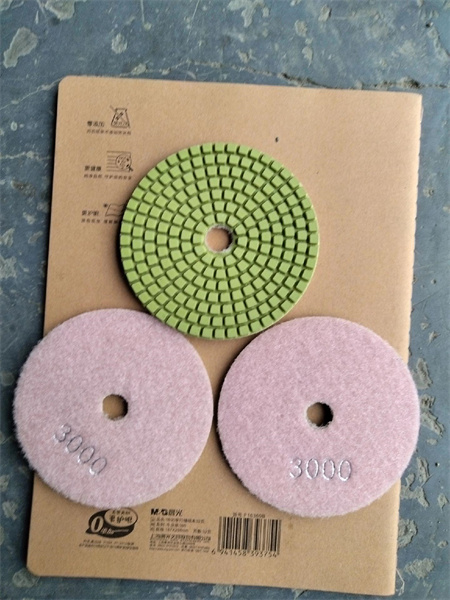
Pad material and bond formulation determine the workability on different stone types. Resin bond pads are typically used for marble finishing and finer polishing stages because their softer bond exposes new diamond edges and produces higher gloss levels on softer stones. Metal bond pads excel in granite polishing and aggressive stock removal stages due to their superior heat resistance and longer lifespan under high cutting loads. Hybrid bond formulations combine characteristics of both resin and metal bonds to balance cutting speed, gloss, and wear rate—often preferred for mixed-material projects or concrete polishing where a compromise between removal rate and surface sheen is required. Our formula development experience includes tailoring bond hardness and filler systems to specific stone hardness and abrasiveness.
Diamond quality and grit systems are equally critical. We work with synthetic industrial diamonds produced via controlled processes and graded by micron size and mesh number. Coarse grits (for example 30–80) are used for initial shaping and heavy material removal, medium grits (80–400) for refining and honing, and fine to ultra-fine grits (800–3000) for high-gloss finishing and polishing. Monocrystalline synthetic diamonds offer consistent cutting action and longer life in many applications, while polycrystalline grades can provide faster stock removal at lower cost. Selecting the appropriate diamond grade and grit progression is essential for predictable granite polishing, marble finishing, or concrete polishing workflows.
Manufacturing processes strongly influence pad consistency and performance. Hot pressing produces dense, uniform segments with reliable bond-diamond integration suitable for metal bond pads, while cold pressing followed by controlled curing is common for resin bond pads to achieve desired porosity and flexibility. Curing regimes—including temperature profiles and post-pressing dwell times—are optimized to ensure bond stability and minimize batch-to-batch variability. Backing systems such as Velcro or generic hook-and-loop are offered for rapid pad change on polishing machines; some architectural projects require reinforced abrasive-backed pads or specific mounting plates, which we can OEM-produce in volume.
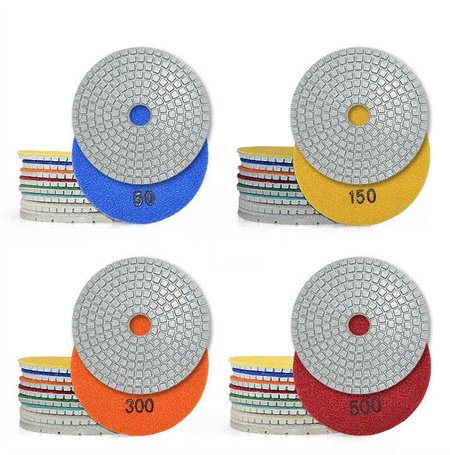
Performance factors—cutting speed, achievable gloss level, pad lifespan, and heat resistance—depend on the combination of bond formulation, diamond grade, segment geometry, and cooling practices during operation. Proper coolant application and correct RPM extend pad life and improve surface results, particularly on heat-sensitive materials like marble. For high-throughput fabrication, pad longevity and consistent removal rates reduce total cost of ownership.
Quality control and export readiness are integral to supplying international markets. Raw diamond grade verification, bond hardness testing, adhesion and wear testing, as well as dimensional checks are part of routine production controls to guarantee batch consistency. International export packaging practices include moisture-proof inner packaging, shock-resistant cartons, palletization, and compliance with phytosanitary and fumigation requirements where relevant. Standard export documentation such as packing lists and certificates of origin are prepared to facilitate customs clearance.
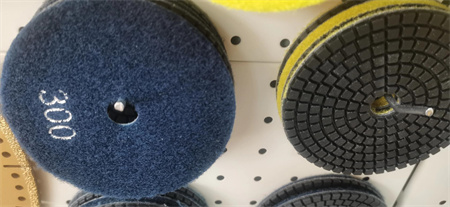
For B2B buyers in the stone fabrication industry, selecting diamond polishing pads requires attention to bond type, diamond grade, grit progression, and supplier production controls. Experience in formula development, reliable OEM manufacturing capacity, and strict quality control ensure pads perform predictably across granite polishing, marble finishing, and concrete polishing applications.