For buyers in the stone fabrication industry, understanding the practical differences between Chinese and European diamond polishing pads helps match product selection to job requirements and budget constraints. With over 30 years of export experience in diamond polishing pad manufacturing, I will outline objective contrasts in materials, production methods, performance factors, quality control, and packaging — all from the perspective of a factory-level OEM producer.
Material systems typically fall into three categories: resin bond, metal bond, and hybrid bond. European manufacturers often emphasize tightly controlled resin formulations and premium metal-bond compositions designed for specific high-hardness stones and long life under sustained production. Many Chinese factories offer a broad portfolio across resin, metal and hybrid bonds, with extensive formula development capability to tune hardness, porosity and heat resistance for granite polishing, marble finishing, or concrete polishing applications. This versatility supports customized pads for varied stone polishing steps in the fabrication workflow.
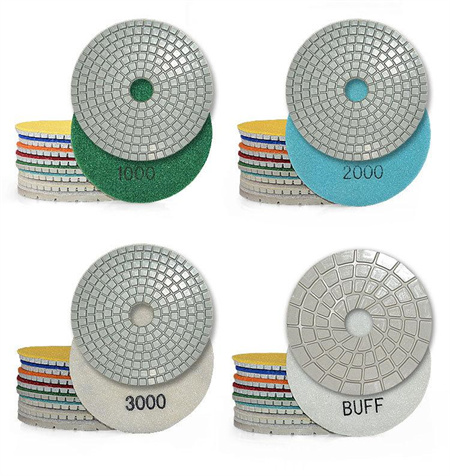
Synthetic diamond quality is another core differentiator. European suppliers commonly specify high-purity, controlled particle-size diamonds and adhere to specific grit grading systems. Chinese producers have also advanced access to synthetic diamond grades across the full range — from coarse micron sizes used for aggressive stock removal to ultra-fine grit for final gloss. Manufacturers experienced in export often provide options using different grit systems (P-scale, micron-based or industry customary numbering such as 50–3000 grit ranges) to align with international stone polishing tools standards and customer preferences.
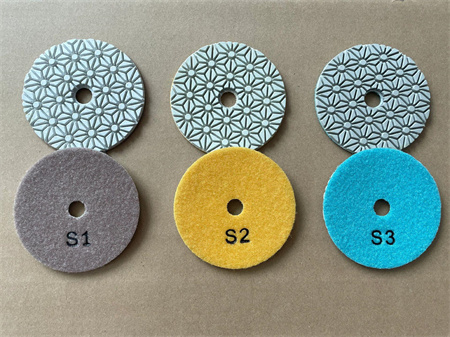
Production processes influence pad performance and consistency. European factories frequently utilize precision hot-pressing and carefully monitored curing cycles to produce dense, thermally stable segments. Leading Chinese factories employ both hot pressing and cold pressing followed by controlled curing, and have scaled production capacity to meet large OEM orders. Hot pressing generally yields higher initial cutting speed and improved heat resistance, while carefully formulated cold-pressed pads can offer consistent results at competitive cost. The curing stage is crucial across regions for bond integrity and lifespan.
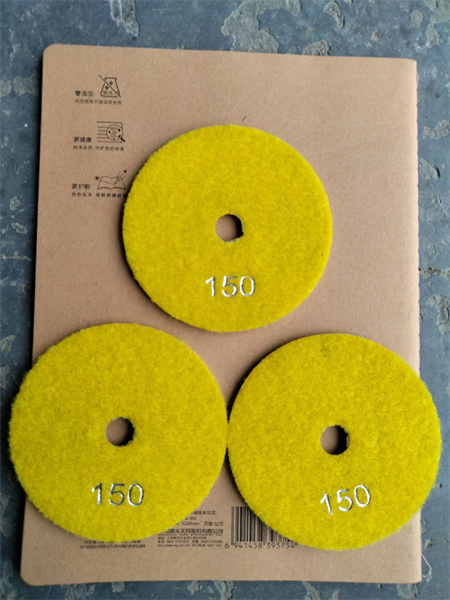
Backing systems are comparable in function: hook and loop (Velcro) backings remain the industry norm for rapid pad changes on handheld and planetary polishers. European pads sometimes emphasize higher-grade backing materials for longevity under heavy mechanical stress; experienced Chinese manufacturers match these specifications when producing OEM runs and can adapt backing thickness, adhesive layers, and perforation patterns to suit specific machines used in stone fabrication.
Performance factors such as cutting speed, gloss level, lifespan and heat resistance depend on an optimized combination of diamond grade, bond formula, grit progression and segment design. European products often prioritize consistent high gloss and durability, especially for premium marble finishing. Chinese production strengths lie in flexible formula development, allowing customization of cut-to-life ratios for granite polishing or concrete polishing needs at scalable volumes. Batch consistency is achievable when factories implement robust quality control standards: diamond concentration checks, particle-size analysis, bond hardness testing, cutting-rate trials and gloss measurement under controlled conditions.
For international buyers, packaging and export practices are practical considerations. Established exporters consolidate pads with moisture-proof inner packaging, shock-resistant cushioning, clear labeling of grit systems and lot numbers, and palletization compliant with ISPM15 where wooden materials are used. Proper export documentation and standardized cartonization reduce transit damage and simplify inventory control for wholesalers and distributors.
In summary, European diamond polishing pads often emphasize precision formulations and premium materials, while Chinese manufacturers provide extensive OEM capacity, adaptable formula development and competitive scalability. For importers, wholesalers and workshop owners, the optimal choice depends on required performance attributes, production volume and the willingness to specify custom bond and backing options suitable for granite polishing, marble finishing, concrete polishing and broader stone polishing tool applications.